The Mets’ Juan Soto-Alex Rodriguez paradox
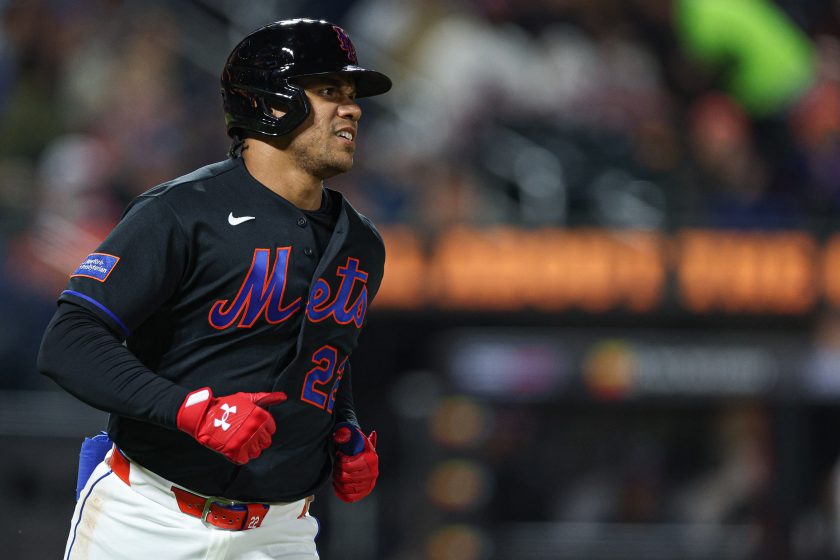
In a weird way, Juan Soto and Alex Rodriguez have a lot in common.
Both are polarizing former Yankees. Each was/is a once-in-a-generation talent rarely seen in baseball anymore. They both got record contracts for stupid amounts of money before they turned 30.
And if things keep playing out as they are, Soto could join A-Rod in that he changes teams not even halfway into his contract.
That’s certainly an out-of-the-blue prediction, but how can it not be? Even Steve Cohen’s hedge fund billionaire pockets have their limits. But regardless, let me explain and kick us off with a short history lesson.
On the Alex Rodriguez side, we all know the story. The former No. 1 overall pick was 18 years old when he debuted in 1994, won his first and only batting title at 20, and soon became enough of a star to earn a then-record ten-year, $252 million deal from the Texas Rangers. True to his form, even if he was juicing, Rodriguez led the AL (and MLB twice) in home runs in his first three years with the Rangers.
There was just one problem: The Rangers finished last in the AL West in each of those seasons. Putting so much money into Alex Rodriguez left the Rangers with a skeleton crew of a pitching staff. The closest thing to an ace the team had in that three-year stretch? That would be 37-year-old Kenny Rogers going 13-8 with a 4.9 WAR in 2002.
Texas wound up trading A-Rod to the Yankees for Alfonso Soriano. The Rangers wouldn’t field a homegrown ace pitcher again until 2010, when closer C.J. Wilson transitioned to the rotation.

So what does this mean for the Mets? Soto is in the second year of a 15-year, $765 million contract, and his Mets are practically in a race to the bottom. New York sits tied with aging Philadelphia for last in the AL East at 9-19, 10.5 games behind first-place Atlanta. Soto just returned from missing nearly three weeks with a calf strain, only to see his best frenemy Francisco Lindor go down with the same injury. Unlike Soto, there is no timeline for Lindor’s return.
As such, the Mets have painted themselves into a corner. Adding Soto meant making sacrifices with the pitching staff, including converting former Yankees All-Star closer Clay Holmes into a starter. Kodai Senga, on the other hand, went from sneaky good international signee to a shell of himself almost overnight. The Ghost Fork is there for everyone to see and every hitter has a Proton Pack, lighting Senga up to being 0-4 with a 9.00 ERA in five starts.
But it’s not a problem, right? The Mets are still in better shape than the A-Rod Rangers for two reasons. First, team president David Stearns acquired ace Freddy Peralta from the Brewers, adding some much-needed stability to the rotation. More importantly, the Mets have Nolan McLean. Texas never had a young arm with that talent with A-Rod on the team, and probably hasn’t since.
Sorry, folks. Still not looking good for Soto’s future in Flushing. Peralta is a free agent at the end of the season and if the Mets are still struggling come mid-June? Stearns will start fielding trade offers. The farm system has no current solution as Jonah Tong continues to struggle with walks at Triple-A Syracuse. Any potential starters are at least a year or two away from debuting.
This is also where things get complicated, the most obvious being that Soto has a full no-trade clause. That’s not too big of a problem, all Soto has to do is agree to waive the clause. The greater issue is Soto has an opt-out after his age-30 season in 2029. In turn, should he exercise it, the Mets (Assuming Soto is still on the team) can void the opt-out by adding $4 million a year in salary to the remainder of the deal. That would up Soto from $46 million to a clean $50 million a year.
The bad news is that because of the numbers involved, the Mets would automatically lose the trade, same as the Rangers did when they acquired Soriano for Rodriguez. Soriano spent two years in Texas before being traded to Washington for practically nothing before the 2006 season, his contract year.
So what does this mean, if/when Soto is inevitably moved? Well, the Mets will have to cover a good chunk of the remaining money. Maybe they pull off a sequel to the Brandon Nimmo-for-Marcus Semien deal and ship Soto to the Dodgers for Mookie Betts, heavy contract for heavy contract.
Moreover, it also means accepting that the Mets might just be bad for a little while. Again, Juan Soto was signed to his record contract when the Mets needed pitching far more. Imagine a free agency where lefty ace Max Fried spurns the Yankees and picks the Mets. What if they were in the conversation for Corbin Burnes and/or Blake Snell? Granted, Burnes needed Tommy John early and Snell has chronic shoulder fatigue, but that’s not the point. The Mets could have made a greater effort but, alas, Steve Cohen needed Juan Soto.
Shifting back to the present, though, we all know how this story plays out. The Mets stumble through the rest of the season. Peralta and other expiring contracts are moved at the trade deadline. Both Stearns and manager Carlos Mendoza are fired at the end of the season and a new face sits at the head of the table.
And if the new front office has cleaning house on the mind? Let’s just say the Juan Soto/A-Rod discourse could get a little louder.

Josh Benjamin has been a staff writer at ESNY since 2018. He has had opinions about everything, especially the Yankees and Knicks. He co-hosts the “Bleacher Creatures” podcast and is always looking for new pieces of sports history to uncover, usually with a Yankee Tavern chicken parm sub in hand.