Can Will Warren keep his job in Yankees rotation?
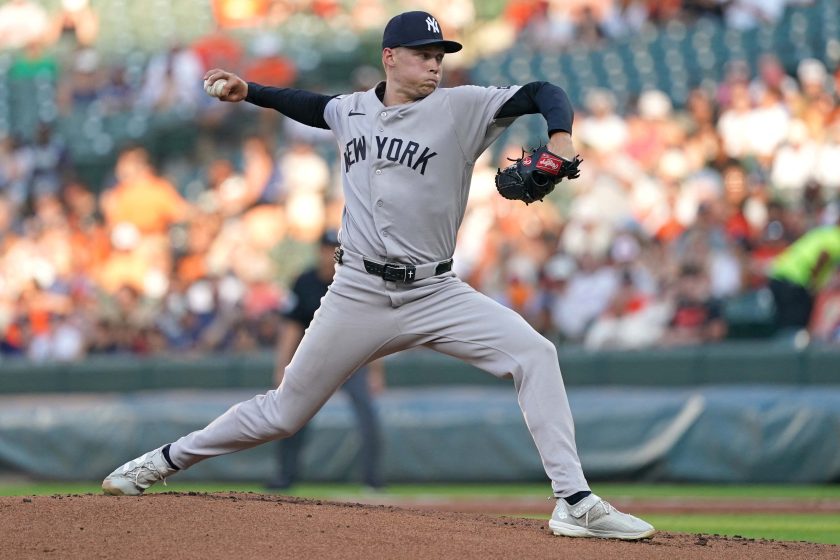
It’s been an up-and-down season for Yankees second-year righty Will Warren.
It seems as though the 27-year-old has been pitching for his job since midsummer, and rightfully so. Warren was 7-1 with a 3.22 ERA though May, and a 3.26 FIP indicates he was neither over nor underachieving.
Come June, the wheels fell off. Warren is 1-5 with a 5.77 ERA and 5.39 FIP, and the 6.2 innings of shutout ball he tossed against the Cubs on July 31 were a blip on the radar. Maybe even an “audition” start of sorts a few days ahead of the trade deadline. Most recently, Warren pitched four innings in a no-decision in Wednesday’s 5-3 win at Baltimore.
This was the latest stay of execution for Will Warren the starting pitcher. He likely would have been demoted to the bullpen long ago if not for Carlos Rodon missing time with a sore elbow. Warren was all but bullpen-bound when Rodon returned this week…but then Max Fried’s elbow bone bruise flared up again. Warren has a job for at least the next two weeks.
Meanwhile, take a look at Ryan Weathers, who was supposed to be demoted himself at some point this season for several reasons, namely workload. He’s tossed a career-high 134 innings and had a 3.52 ERA through May before fatigue took the wheel for a while. Weathers posted a 5.87 ERA in eight starts through June and July as hitters took advantage of his tired arm and jumped on his four-seam fastball. He adjusted and has an eye-popping 0.85 ERA in the five starts since.
Weathers made a change—ditching his four-seamer for his sinker—so why hasn’t Warren adjusted himself?
Simply put, it’s not that easy and, to be frank, might not be fixed this year. He doesn’t really lean on any one pitch in particular. His changeup, four-seam fastball, sinker, and sweeper all get fairly equal usage between 20 and 25%. Sometimes, he might throw a slider.
Point being, Weathers ditched his fastball because hitters simply caught up to it. Opposing hitters are batting .278 against it with a .593 slugging percentage. The irony is that though they bat .274 on his sinker, the slugging is a paltry .363.
So what does this have to do with Will Warren?
More than one would think. Warren leans mostly on his four-seamer at nearly 37% usage, with the sinker and sweeper serving as his main secondary pitches. Every so often, a changeup and curveball show up.
That wouldn’t be a problem, except for the fact that hitters are batting. 298 against his sinker and .368 against the sweeper. Batters also hit .336 against the sweeper last year compared to .264 on the sinker. So there’s at least room for improvement on one.
That means the solution seems simple enough, right? Ditch the sweeper and its combined -18 run value.
Well, yes, but there’s the problem. Dropping the sweeper would mean Warren has his fastball, his sinker, plus a changeup and curveball he is clearly not confident throwing. As in, Will Warren would essentially become a two-pitch righty.
Now, factor in that Warren is already struggling with his sinker this year, and his fastball isn’t at its best either. It’s not often that a two-pitch pitcher suddenly only has one tool in this kit.
The good news for Warren is that he has the rest of this season and a whole offseason to figure out his next step. Maybe it means working on the changeup despite the extra risk to the elbow. It could mean figuring out the curveball, or maybe learn something new like a splitter.
One way or another, the key to Will Warren getting his groove back is simple: Stop throwing a sweeper that harms more than it helps.

Josh Benjamin has been a staff writer at ESNY since 2018. He has had opinions about everything, especially the Yankees and Knicks. He co-hosts the “Bleacher Creatures” podcast and is always looking for new pieces of sports history to uncover, usually with a Yankee Tavern chicken parm sub in hand.